ToyZone began as a family toy shop in Shah Alam Market, Lahore, run by the grandfather of its current CEO, Hamza Waseem. Hamza studied marketing in London and co-founded the move online. Registry data dates the business to 2014; the founder dates it to 2015. It began as a wholesale supplier, and its D2C store was framed around a simple promise — give ordinary parents wholesale-level prices. It still runs a separate wholesale and dropshipping storefront.
Tracxn lists about six employees and no external funding. That makes ToyZone one of the clearest examples of a bootstrapped Pakistani D2C business built on an existing supply chain. "Biggest toy store" claims are positioning rather than audited fact, and I treat them that way below.
The short version
Toys are already a proven online category in Pakistan, and the channel is still wide open. Even the category leader has visible execution gaps — stale copy, placeholder text, unanswered price questions — which means creative QA and fast replies are cheap advantages for anyone entering now.
The business model
The Shopify store is organised two ways — by age band from 0 to 12+, and by type: RC and vehicles, blasters and action toys, baby, educational, art, games, costume, plus a "household and gadgets" section of non-toy impulse items. Price-tier collections run from under Rs 499 to under Rs 4,999, an AI toy finder recommends age-appropriate gifts, and the homepage is re-merchandised around whatever is trending — gel-ball and electric blasters at the time of review.
A trust stack built for COD gift buyers
Toys have a specific trust problem: the person paying is often not the end user, and most pay cash on delivery. ToyZone answers that directly. It runs five courier partners for redundancy, accepts COD, bank transfer, cards and JazzCash, and sells trust as paid checkout add-ons priced at Rs 249–450 — a battery pack, protective packaging, priority dispatch, a video check before dispatch and a 7-day replacement cover.
Monetising trust is smart. The weaker points are the 24-hour window for damage complaints, refunds that take up to seven working days, and a reviews page that openly excludes "fake" one-star reviews. Self-curated reviews and "100% Original" badges are an industry-wide credibility problem in Pakistani toys, not a ToyZone one — but the leader is best placed to fix it.
The social footprint is real: about 512,800 Facebook followers, 190,700 on Instagram across nearly 6,000 posts, 12,400 on TikTok, and a WhatsApp Business line as the main service channel.
How big is the opportunity?
Depending on definition, Pakistan's toy market is about $632 million (toys and games, 2024) or about $2.1 billion including hobby and sporting goods. Either way it is well under one per cent of a $120–142 billion global market, in the world's fifth most populous country.
The demographics are the case. Pakistan's population is around 259 million with a median age of 21.8, and roughly 36–37 per cent are under 15 — about 93–96 million children. Fertility of around 3.5 keeps renewing that base. Toys, hobby and DIY already rank fifth among online categories by revenue, behind electronics, furniture and appliances, fashion, and food and personal care. Online accounts for somewhere between 15 and 35 per cent of global toy sales; in Pakistan, eCommerce is still a fraction of a per cent of total retail.
Seasonality matters more than most toy sellers plan for. Eid-ul-Fitr is the peak, followed by Eid-ul-Adha, Ramzan, the December break and back-to-school. Eid moves 10–11 days earlier every year, so the calendar has to be lunar.
Meta: high-volume testing, uneven polish
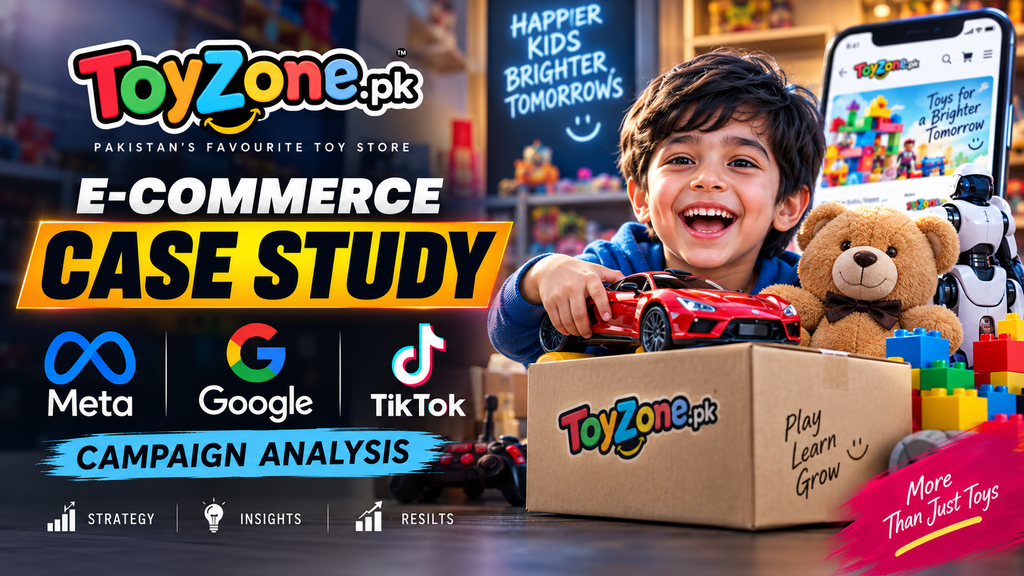
ToyZone had about 34 active Meta ads across STEM sets, card games, blasters, dolls, adult collectibles, RC cars, ride-ons, crafts and outdoor toys. The strengths are exactly what a COD market needs: cash-on-delivery and WhatsApp messaging in almost every ad, gamified spin-the-wheel remarketing with 24-hour urgency, video demos, structured testing and smart targeting of adult collectors.
The weaknesses are polish: pandemic-era copy still live, placeholder text ("Product Description....") in a running ad, duplicated creatives, 15–20 hashtags per ad, bold Unicode text in headlines and non-toy novelty items diluting the brand. Meta's library shows no spend data for Pakistan, so this is a creative read only.

Google: full funnel, one note
The 43 Google ads cover search, call-only, shopping, dynamic display remarketing, Discovery and YouTube — a genuinely full funnel with live feed pricing and call and WhatsApp extensions. The read is technically competent but one-note: nearly every ad leads with a discount, descriptions are templated, a sitelink says "Toys For Girs", and claims like "most trusted" and "No. 1" are unsubstantiated.

TikTok: viral by accident
ToyZone's TikTok has 12,400 followers and more than 150 videos since 2020. Its two biggest hits — 3.4 million and 2.5 million views — were novelty "magic finger light" clips, not toy demos, which typically earn 300–2,000 views. The comments show real purchase intent, but price questions go unanswered, there is no bio link, no on-screen call to action since 2020, no TikTok Shop and no sign of paid promotion.

What a challenger should do
Pakistan sits in a low-cost ad tier — CPMs of roughly $5–12 — with around 80–85 million social media identities. The funnel that fits toys is cheap organic video for awareness, price-tier collection ads, a COD-friendly product page, then WhatsApp for retention. Creative that works: unboxings, children's reactions, "pay on delivery" messaging and vertical video. White space exists in premium and STEM toys. The risks are real too — weak PSQCA enforcement, China import and currency exposure, COD reverse-logistics costs, Daraz price pressure and ad costs that spike in Eid windows.
What transfers to your business
- Use an existing supply chain as your price advantage — wholesale roots are a moat.
- Sell trust as an add-on: protective packing, video checks, replacement cover.
- Run courier redundancy; one partner is a single point of failure.
- Plan campaigns on the lunar calendar.
- QA every live ad monthly — placeholder text and stale copy cost conversions.
- Answer price questions in TikTok and Instagram comments. That is where the intent is.
Category leaders are rarely as far ahead as they look from outside. If you are building in toys, kids or any gift category, I help brands plan this as an eCommerce consultant and on Meta, Google and TikTok strategy.